Every mover in New York has watched the same scene: a sofa that looked perfectly normal in a Brooklyn living room, now wedged in a Manhattan doorway at an angle nobody planned. “Will my couch fit through the door?” is the question people ask us the night before a move, usually around 11 p.m. The honest answer is that nobody should be guessing. A crew does not guess. It measures three numbers, and so can you.
This guide is about fit, not price. What a walk-up does to your bill is covered in our walk-up moving guide. Here we answer one thing: will the piece go through, and what happens if it will not.
Will the Couch Fit Through the Door? Three Numbers Decide
Does the couch fit through the door? Three numbers answer that: the door’s clear width, the sofa’s diagonal depth, and the tightest point anywhere on the path between the truck and the room. The rule, the same one furniture retailers use for deliveries, is simple: if the sofa’s diagonal depth is less than the door’s clear width, the sofa goes through standing on its end. If it is not, the crew has work to do before it goes anywhere.
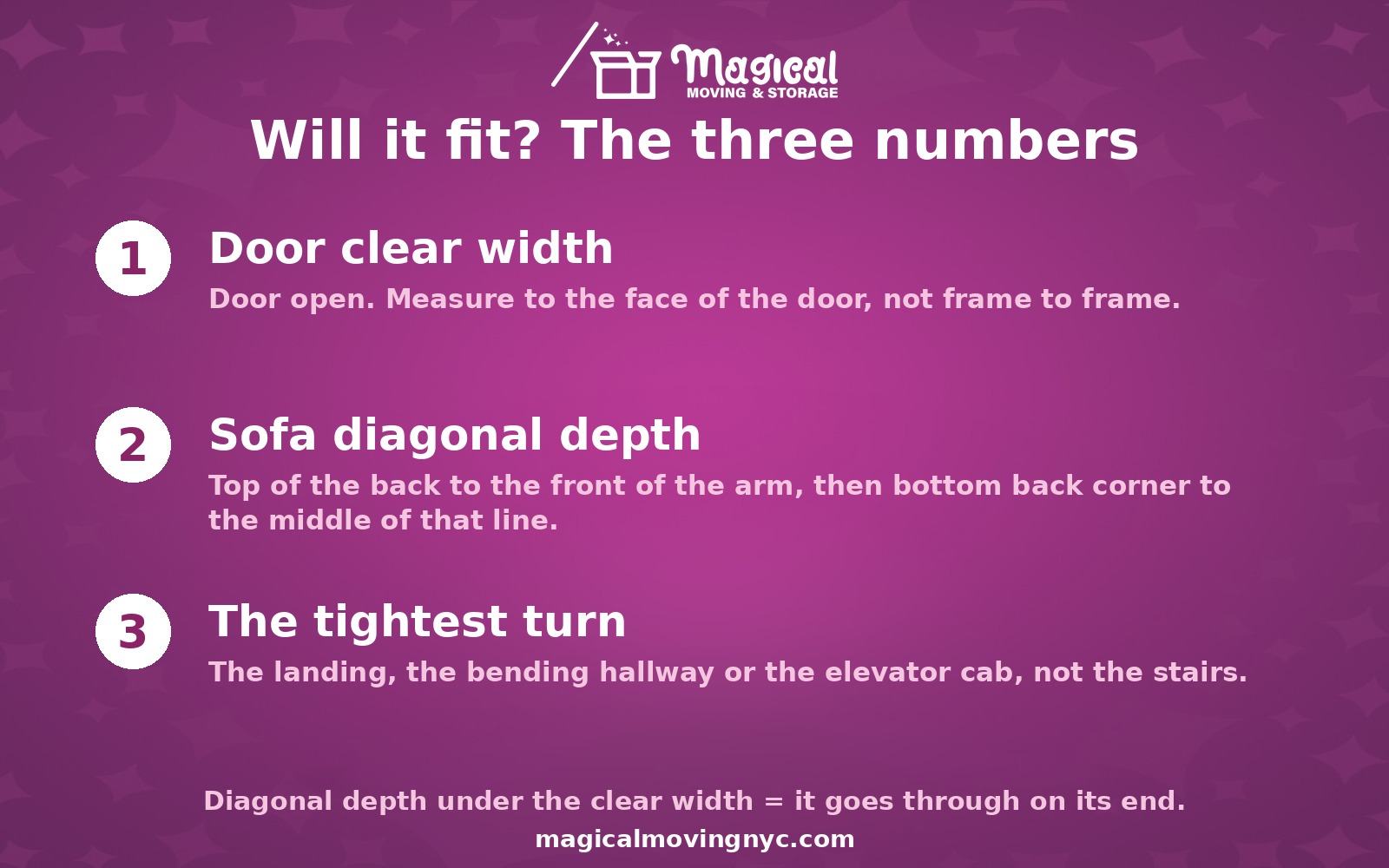
Number one, door clear width. Open the door all the way and measure from the inside edge of the frame to the face of the door itself, not frame to frame. A door sold as 30 inches gives you roughly 28 and a half with the door still hanging. Taking it off its hinges hands most of that back, which is why crews pull doors so often. Measure the height too, and note any knob or lever that sticks into the opening.
Number two, sofa diagonal depth. Stand at the end of the sofa, cushions off. Lay a straight edge from the highest point of the back frame to the front of the arm. Now measure from the bottom back corner of the sofa up to the middle of that straight edge. That is the diagonal depth, and it is the number that decides whether the pivot works. A typical sofa about 34 inches deep, 30 inches high at the back, with 22-inch arms, measures about 30 inches diagonally. Unscrew the legs and the same sofa measures about 27. Three inches is the whole difference between a couch in your living room and a couch on the sidewalk.
Number three, the tightest turn. The apartment door is rarely the narrowest point. It is the hallway that bends, the landing halfway up the stairs, or the elevator cab. Walk the route from the curb to the room and measure wherever it gets tight.
Measure the Door the Way a Crew Does
Three doors matter, and people usually measure one. The building entrance is normally the widest. The apartment door is the one everyone worries about; in an older walk-up it can be 30 inches, while newer buildings usually give you 32 to 36. The door people forget is the bedroom door, often the narrowest in the apartment, which is why beds come in as parts and why the box spring is the piece that causes the trouble.
The Stairs Are Not the Problem. The Turn Is.
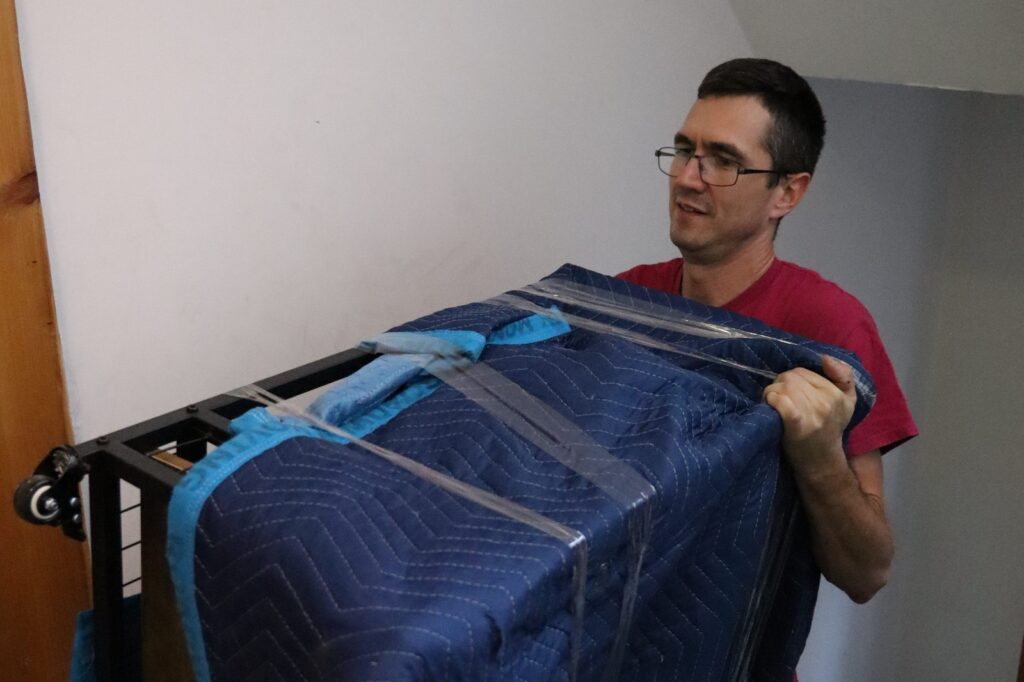
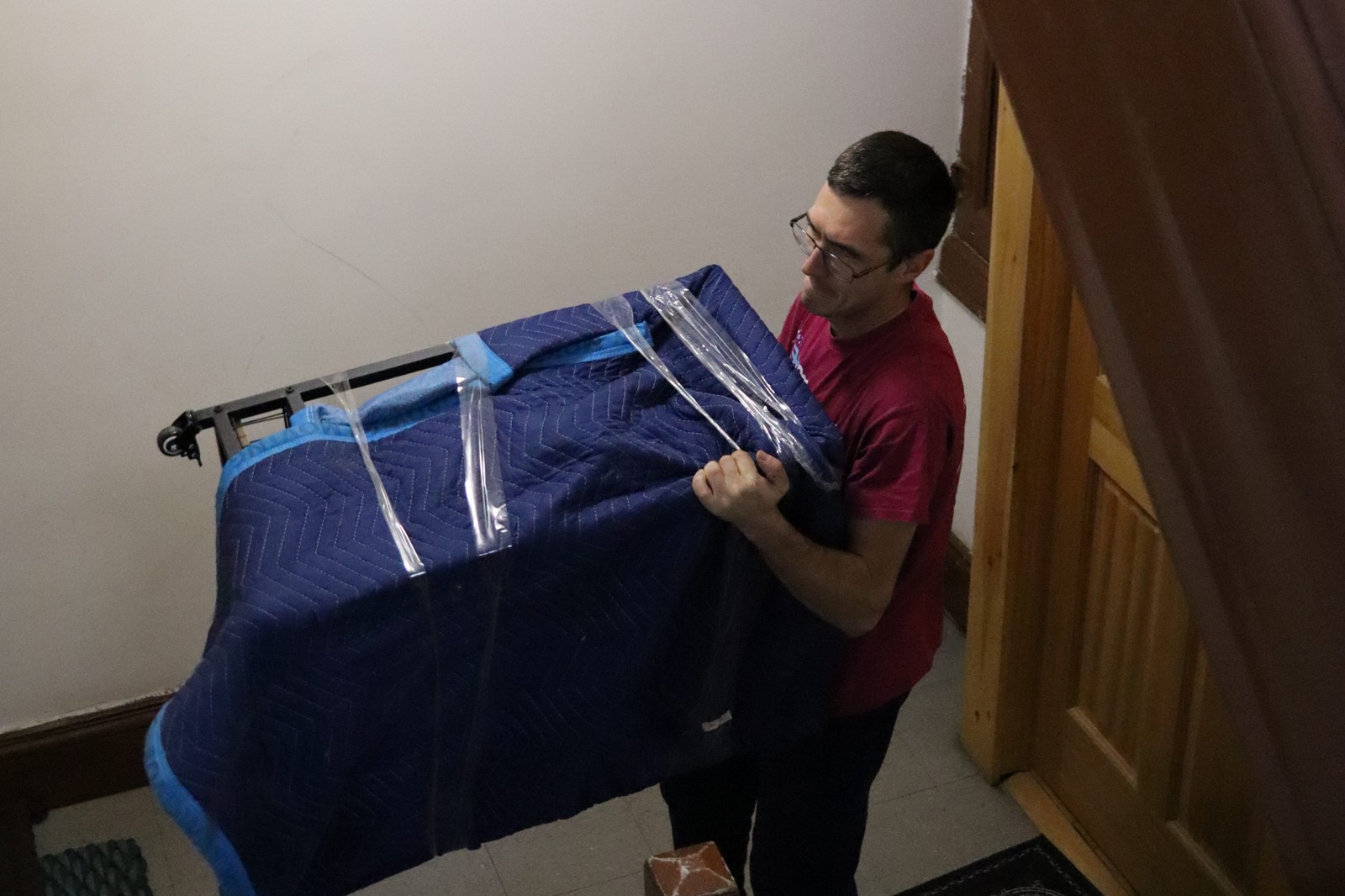
Stairs in a walk-up are almost never too narrow for furniture. The landing is the trap. A long piece like an 84-inch sofa or an 80-inch queen box spring has to stand up and pivot on the landing to make the switchback, so the number to check is the ceiling height at the landing against the length of the piece, plus a couple of inches for hands and moving pads. A banister or newel post that eats into the landing counts too. This is where a crew earns its money: the pivot, the tilt, the inch gained by taking a door off its hinges.
In an Elevator Building, the Cab Is the Door
In an elevator building the numbers move to the cab: door width, cab depth, cab height, and the corner-to-corner diagonal inside. An 84-inch sofa or a queen box spring usually rides standing up, tilted into that diagonal, which works in most cabs and fails in some small pre-war ones. Most Manhattan buildings also want the service elevator reserved and padded, with a certificate of insurance on file; our elevator reservation guide walks through that paperwork.
What Comes Apart and What Does Not
Basic disassembly and reassembly is included in every Magical Moving job, so the question is not whether we will take it apart but whether it can be taken apart.
- Bed frames, dining tables, desks: come apart, go back together, rarely a problem.
- Sofas: the legs come off almost always, and that alone solves a surprising number of doorways. Some newer brands bolt their arms and backs on; most traditional sofas do not, and their frames do not come apart without a specialist.
- Sleeper sofas: the steel mechanism is the issue. It is heavy and it is the reason sleepers get stuck where regular sofas do not. On many models the mechanism unbolts and travels separately.
- Sectionals: break into pieces and are rarely a problem, which surprises people who own one.
- Wardrobes and flat-pack furniture: must come apart. Be honest with yourself about particleboard and cam locks; they do not love being rebuilt more than once or twice.
- Box springs: do not bend, do not come apart, and a 60 by 80 inch queen is the single most common piece that will not make a walk-up landing. Foam mattresses fold; box springs do not. If you are buying new, a split queen box spring exists for exactly this reason.
- Marble and glass tops: do not flex and cannot be forced. They get crated and carried flat.
- Pianos and pool tables: have their own playbook and their own crews. See our piano moving and pool table moving pages.
When It Will Not Go: Five Honest Options
Sometimes none of the above makes the couch fit through the door. Here is the order a good crew works through.
Legs off, door off, pivot. This is the crew’s first fifteen minutes on a tight doorway, and it solves most of them.
A different route. A service entrance, a wider back door, the courtyard side of the building. Crews check this before anyone starts forcing anything.
A couch surgeon. New York has specialists who take a sofa’s frame apart in the hallway and rebuild it in the room, at published prices of roughly $275 to $600 depending on the piece. It sounds extreme until you price a new sofa.
Hoisting through a window. Real, and New Yorkers do it; Brick Underground has the story of a marble tabletop craned into an Upper West Side apartment. It is a specialty job with its own crew, its own price, and a building that has to allow it. Nobody does it on the fly, and nobody should ever use a fire escape. If a piece is headed for a hoist, we tell you before move day, not on it.
Let the piece go, or let it wait. Sometimes the math says the sofa is worth less than getting it upstairs. Sell it, or put it in storage until the next apartment has a better door. A good crew will say that out loud instead of selling you an afternoon of forcing.
Tell Us Before Move Day
Every piece of furniture that ends up stuck is a piece nobody measured. When you book, tell us about the sofa, the sleeper, the wardrobe, the marble top, and send two photos: the piece, and the narrowest door it has to clear. With the three numbers above we can tell you in advance which pieces walk in, which come apart first, and which need a plan B. On the day, we will make the couch fit through the door or tell you exactly why it cannot. Our NYC moving cost guide covers what the rest of the move costs.
The Bottom Line
Will your couch fit through the door? Measure the door’s clear width, measure the sofa’s diagonal depth, and walk the route for the tightest turn. If the diagonal depth is under the clear width, it goes. If it is close, the legs come off and the door comes down to make the couch fit through the door. If it is not close, there are five honest options and forcing it is not one of them. We have carried a lot of sofas up a lot of stairs, and we are backed by 901 five-star Google reviews. Call (212) 933-9959 or get a flat quote.
Magical Moving & Storage is a licensed and insured NYC moving company. USDOT 4144902, MC 1589978, NYSDOT 42311. Local moves from $295, basic furniture disassembly and reassembly included.