One in three apartments in New York City sits in a building with no elevator. That is 1.03 million homes reached by stairs, spread very unevenly across the five boroughs, and as far as we can find, nobody had put them on one map.
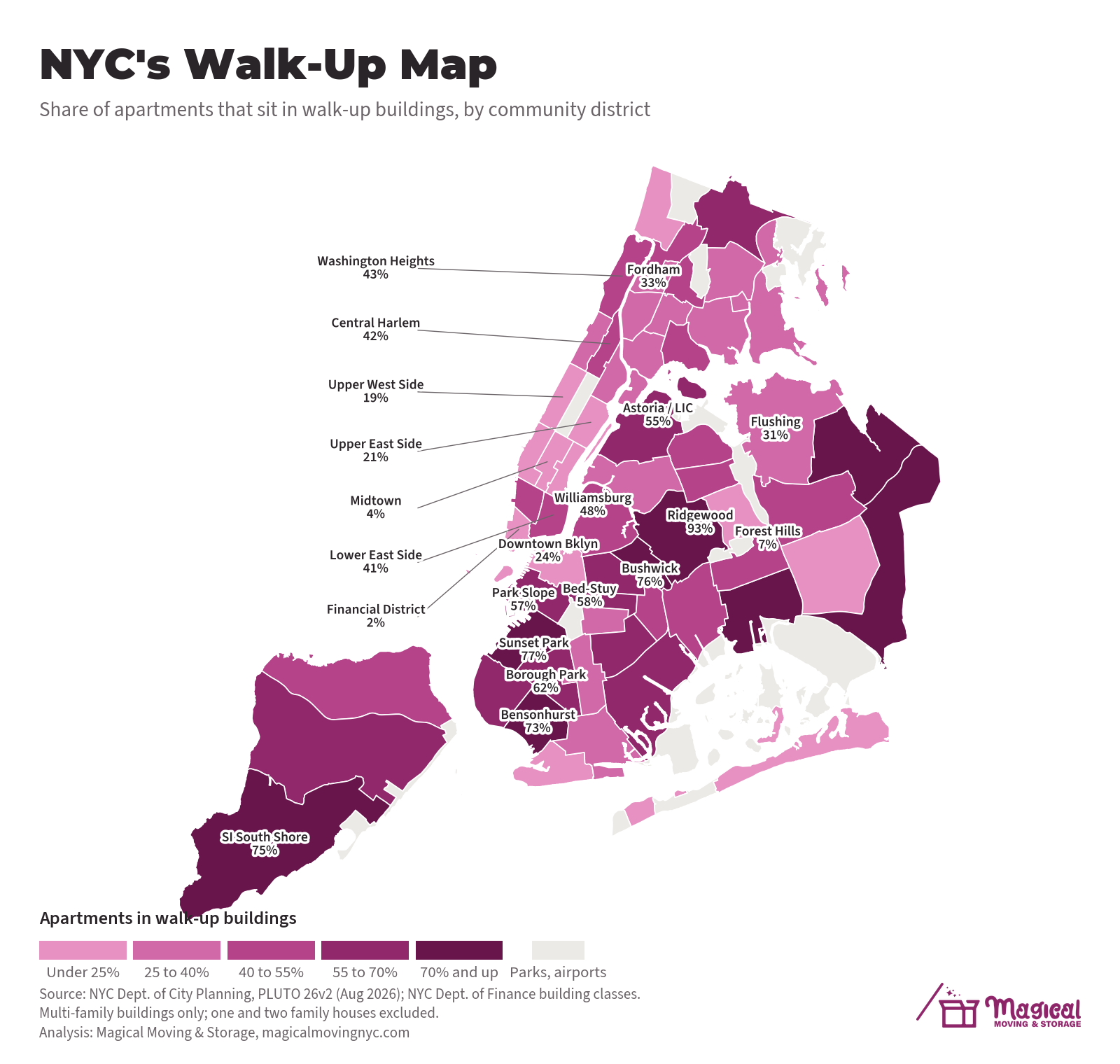
We did, using the city’s own property records. The Department of City Planning publishes a dataset called PLUTO that describes every tax lot in New York, and the Department of Finance classifies every apartment building in it as either a walk-up or an elevator building. Add up the apartments in each class, sort by community district, and you get the map below: the share of walk-up apartments in NYC neighborhood by neighborhood, from 2% to 93%.
We are movers, so we read this map one way. A fourth-floor walk-up in Ridgewood and a fourth-floor apartment in a Midtown tower are the same apartment on paper and completely different jobs on the day. This is the first time anyone can see where the walk-up apartments in NYC actually are, neighborhood by neighborhood.
What counts as a walk-up
The Department of Finance sorts every residential building in the city into a building class for tax purposes. Class C is “walk-up apartments” and class D is “elevator apartments.” Both cover buildings with three or more units, which is what most New Yorkers mean by an apartment building. Class C runs from three-family houses and converted rowhouses to old-law tenements, walk-up co-ops and garden apartments. Class D runs from the six-story pre-war with a single slow elevator to the newest glass tower.
We counted the apartments in every class C and class D building in the city, added the condo buildings the same records mark as walk-up or elevator, and left out one and two family houses entirely. Houses have stairs too, but a house is not what anyone means by a walk-up. The full method for counting walk-up apartments in NYC, including what we did with the small number of buildings whose class does not say either way, is at the bottom of the page.
The citywide picture: 37% of apartments, 88% of buildings
New York has about 2.78 million apartments in buildings of three units or more. Roughly 1.03 million of them, 37%, are walk-up apartments. In NYC that share is anything but even, as the map shows. The other 1.75 million are in elevator buildings.
Count buildings instead of apartments and the picture flips. The city has about 148,700 walk-up buildings and about 20,300 elevator buildings. Seven out of every eight apartment buildings in New York are walk-ups; the elevator buildings are simply much bigger.
By borough, the walk-up share of apartments runs:
- Staten Island: 55% (a small apartment stock, about 36,500 units)
- Brooklyn: 48%
- Queens: 42%
- The Bronx: 36%
- Manhattan: 25%
Manhattan’s 25% is the lowest share of walk-up apartments in NYC’s five boroughs and still the third-largest count: about 227,700 walk-up apartments, more than Queens has in total. The difference is what those walk-ups look like, which we get to below.
The walk-up belt: where walk-up apartments in NYC are concentrated
The dark band on the map runs through western Queens and central and southern Brooklyn. Among the 53 community districts with at least 20,000 apartments, these have the highest walk-up share:
| Community district | Walk-up apartments | Share in walk-ups |
|---|---|---|
| Ridgewood, Maspeth, Glendale, Middle Village (Queens) | 28,556 | 93% |
| Sunset Park, Windsor Terrace (Brooklyn) | 22,310 | 77% |
| Bushwick (Brooklyn) | 28,830 | 76% |
| Bensonhurst, Bath Beach (Brooklyn) | 30,945 | 73% |
| Borough Park, Kensington (Brooklyn) | 24,984 | 62% |
| Crown Heights North, Prospect Heights (Brooklyn) | 25,365 | 59% |
| East Flatbush (Brooklyn) | 24,617 | 58% |
| Bedford-Stuyvesant (Brooklyn) | 34,664 | 58% |
| Park Slope, Carroll Gardens, Red Hook (Brooklyn) | 28,648 | 57% |
| Astoria, Long Island City (Queens) | 43,484 | 55% |
| Bay Ridge, Dyker Heights (Brooklyn) | 17,972 | 55% |
| Williamsbridge, Wakefield (Bronx) | 19,344 | 55% |
Community districts with at least 20,000 apartments in multi-family buildings. Source: NYC Dept. of City Planning PLUTO 26v2; NYC Dept. of Finance building classes.
Ridgewood is in a category of its own. Nine out of ten apartments in Queens Community District 5 are in walk-ups, and its main zip code, 11385, holds about 21,400 walk-up apartments, the most of any zip code in the city. Only 28 elevator buildings exist in the whole district.
Astoria and Long Island City are the other headline, for a different reason. The district’s 55% share is middling, but it has the largest walk-up stock in the city at roughly 43,500 apartments, ahead of Greenpoint and Williamsburg at 42,000 and Bedford-Stuyvesant at 34,700. Anyone who has carried a couch up a Ditmars Boulevard staircase already knew this. Now there is a number.
Where the elevators are
The light end of the map, the districts with the fewest walk-up apartments in NYC, is Manhattan below 59th Street, plus a few outer-borough districts built mostly in the elevator era:
- Financial District and Tribeca: 2% of apartments in walk-ups
- Midtown: 4%
- Forest Hills and Rego Park: 7%
- Murray Hill, Gramercy and Stuyvesant Town: 10%
- Coney Island and Brighton Beach: 17%
- Upper West Side: 19%
- The Rockaways: 20%
- Upper East Side: 21%
- Riverdale: 21%
Forest Hills is the outer-borough surprise: only about 3,200 walk-up apartments against nearly 44,000 in elevator buildings, a Manhattan ratio on the Queens side of the river. Coney Island and the Rockaways are elevator districts because their apartment stock is dominated by large towers rather than rowhouses.
The Upper East Side has more walk-up apartments than Bushwick
This is the number that surprised us most about walk-up apartments in NYC. The Upper East Side, the neighborhood of the doorman building, holds about 30,700 walk-up apartments. Bushwick, the neighborhood everyone pictures when they hear “fourth-floor walk-up,” holds about 28,800.
The share is different (21% against 76%), because the Upper East Side has 116,000 apartments in elevator buildings sitting next to those walk-ups. But the walk-ups are there, and they are tall: 86% of the Upper East Side’s walk-up apartments are in buildings of five stories or more, many of them the tenement blocks of Yorkville. Zip code 10128 alone has about 9,100 walk-up apartments and 10028 another 8,000. If you live in Yorkville, the odds that your move involves a staircase are better than the neighborhood’s reputation suggests.
A Manhattan walk-up and a Brooklyn walk-up are different buildings
The map shows where the walk-up apartments in NYC are. It does not show how tall the buildings are, and that turns out to be the more useful fact for anyone planning a move.
Across the city, 30% of walk-up apartments are in buildings of five stories or more. In Manhattan that figure is 79%. In the Bronx it is 56%. In Brooklyn it is 5%, and in Queens 4%.
So the Manhattan walk-up is the tenement: five or six stories, a top-floor apartment five flights up, a narrow stair that turns twice. In Inwood’s 10034 zip code, 98% of walk-up apartments are in buildings of five stories or more. On the Lower East Side (10002) it is 94%, in Washington Heights (10032) 92%, in Yorkville (10128) 92%. The Bronx has the same building type along the Grand Concourse; the 10458 zip around Fordham holds about 16,300 walk-up apartments, three quarters of them in buildings of five stories or more.
The Brooklyn walk-up is the brownstone or the three-family house: three or four stories, wide stairs, a stoop. Even in the brownstone belt the stairs stop early. In Crown Heights North and Prospect Heights, 67% of walk-up apartments are in buildings of four stories or more; in Park Slope 51%; in Bedford-Stuyvesant 47%. In Bushwick it is 27%, in Bensonhurst 26%, and in Ridgewood, the walk-up capital, only 9%. Most of Ridgewood’s walk-ups are two- and three-story buildings, which is why a Ridgewood move is usually easier than the 93% suggests.
Citywide, about 79,400 apartments are in six-story walk-ups, and about 38,200 are in buildings the Finance Department still classifies as old-law tenements, meaning they went up before the Tenement House Act of 1901. The Lower East Side and East Village hold about 5,400 of those, Chelsea and Hell’s Kitchen about 5,800, Central Harlem about 4,900 and the Upper East Side about 4,500. Every one of them is a walk-up by definition.
What this means when you move
We plan every job around the building before we plan it around the address, and walk-up apartments in NYC are the reason that habit exists. Three things follow from it.
The floor matters more than the borough. A second-floor walk-up in Bushwick and a second-floor apartment in an elevator building take about the same effort. A fifth-floor walk-up in Washington Heights is a different job: an extra mover on the crew, a longer day, and furniture wrapped for a stair that turns. What that does to a moving bill, with real numbers, is in our guide to moving out of a NYC walk-up.
Walk-ups skip the paperwork. No freight elevator to reserve, no move-in window set by a building manager, and only rarely a certificate of insurance request. The trade is time on the stairs for time on the phone. That is also why walk-up moves are easier to book at short notice.
Tell your mover the number of flights, not the floor. A “third-floor” apartment in a building with a raised stoop is often three flights up and a half. Count the landings when you send a quote request, or send us the listing link; the photos usually settle it in ten seconds.
If you are choosing where to live and the stairs matter to you, the table above is a decent first filter. Pair it with our map of where New Yorkers actually moved in 2025 and the Priced-Out Map of affordable neighborhoods next to expensive ones, which come from the same kind of public data. For the cost side of any NYC move, walk-up or not, start with how much movers cost in NYC.
How we built the map
Source: the NYC Department of City Planning’s PLUTO dataset, version 26v2 (updated August 2026), downloaded from NYC Open Data. Building classes are the Department of Finance’s building classification codes.
Walk-up apartments in NYC, for this map, are the residential units in class C buildings (walk-up apartments, including walk-up co-ops, walk-ups over stores, old-law tenements and garden apartments), plus condo buildings the records mark as walk-up (R2, and R3 and R6 in one-to-three-story buildings) and three-to-six-family buildings over a store (S3 to S5). Elevator apartments are the units in class D buildings (elevator apartments, including elevator co-ops) plus condo units in elevator buildings (R4).
About 340,000 apartments sit in condo and mixed-use classes whose code does not say whether the building has an elevator. We assigned those by height: six stories or more counted as elevator buildings, three or fewer as walk-ups, and roughly 48,000 apartments in four- and five-story buildings of uncertain type, or with no height on record, were left out. Counting only the buildings the Finance Department labels explicitly gives a citywide walk-up share of 41% rather than 37%, and the same neighborhoods at the top and bottom of the table, so the ranking does not depend on that choice. One and two family houses are excluded throughout.
Two honest limits on any count of walk-up apartments in NYC. A handful of class C buildings have had elevators added since they were classified, and the records will not show it. And PLUTO’s year-built field is an estimate for many older buildings, so we use it only for broad statements like “before 1901,” never for a specific year.
The full tables for every community district and zip code are ours to share. Journalists, brokers and neighborhood groups are welcome to use them with a link back to this page.
Planning a move up the stairs?
Send us the address and the number of flights, or the listing link, and we will tell you the crew size and the arrival window before you book. 939 five-star Google reviews, and a good share of them were written at the top of a staircase. Get a free quote
Magical Moving & Storage. USDOT 4144902, MC 1589978, NYSDOT 42311. (212) 933-9959.