Every conversation about affordable NYC neighborhoods eventually lands on the same move: you do not leave the city, you slide one neighborhood over. The place next to the place you wanted. In Part 1 of this series we showed that New York is not emptying out, and in Part 2 we showed that about half the people who do leave the five boroughs never leave the region. This final part zooms all the way in, to the block level, where the same pattern repeats inside the city itself.
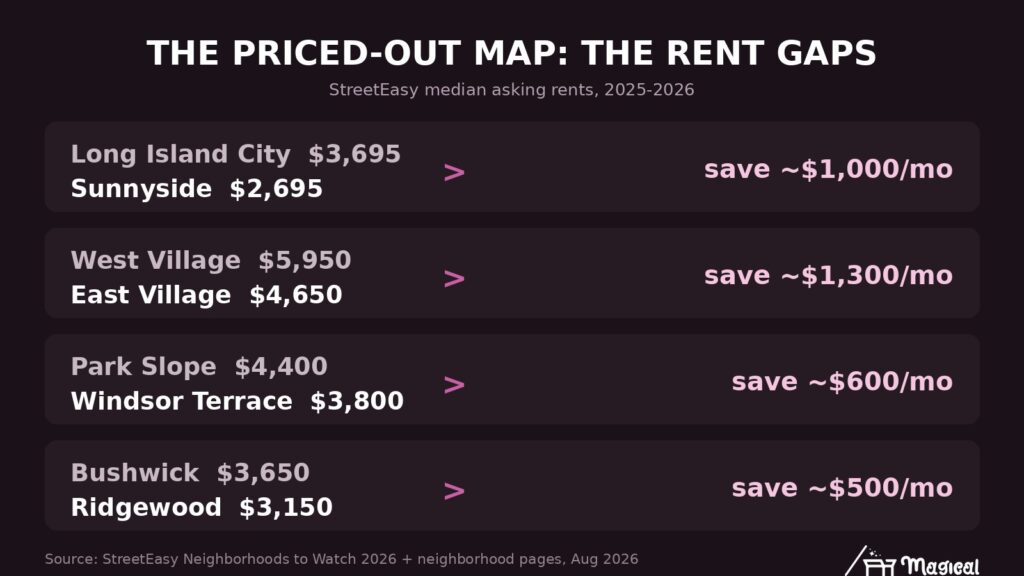
We took StreetEasy’s own demand data and rent figures and mapped the four clearest “compromise” pairings in New York right now: the neighborhood people want, the neighborhood next door that is absorbing them, and the actual dollar gap between the two. Four affordable NYC neighborhoods, four expensive neighbors, four real numbers.
First, What This Map Measures (and What It Does Not)
The starting point is StreetEasy’s 10 NYC Neighborhoods to Watch in 2026, which ranks neighborhoods by the growth in buyer and renter searches from 2024 to 2025. As we said loudly in Part 2: search interest is not migration. Nobody has moved anywhere by searching. What search growth does tell you is where demand is heading, and when a cheaper neighborhood’s searches spike right next to an expensive one, that is the priced-out map drawing itself. It is also the fastest honest way to find affordable NYC neighborhoods that still feel like the place you actually wanted.
One more honesty note. The Watch-list rents are 2025 figures published in January 2026. Where we quote a pricier neighbor’s current rent, it comes from that neighborhood’s live StreetEasy page as of August 2026. Two vintages, both named, so you can check our work.
Sunnyside, for When Long Island City Wins the Bidding War
The single biggest gap on the map. Long Island City’s median asking rent sits at $3,695; Sunnyside, seven minutes further on the 7 train, is $2,695. That is roughly a thousand dollars a month, every month, for moving three stops. Sunnyside’s searches grew 43.7 percent, eighth in the city, and its median asking price of $475,000 makes it one of the last places in western Queens where first-time buyer math still works. The trade: you swap LIC’s glass towers and waterfront gyms for pre-war co-ops, a slower street rhythm, and bakeries that predate the skyline. Our Queens moving guide covers the borough logistics.
Ridgewood, for When Bushwick Stops Being the Cheap One
Bushwick spent fifteen years as Brooklyn’s affordable answer. Its median base rent now shows $3,650 on StreetEasy, and the neighborhood directly across the Queens line, Ridgewood, rents at a median $3,150 with searches up 43.4 percent. A five hundred dollar monthly gap between two neighborhoods that share the L and the M and, in places, a literal street. Ridgewood is what the priced-out map looks like when the “cheap” neighborhood itself gets priced out: same commute, same scene drifting over one border, yellow-brick rowhouses instead of loft conversions.
Windsor Terrace, for When Park Slope Is a Number, Not a Neighborhood
Park Slope’s median base rent is $4,400. One neighborhood south, on the same edge of the same park, Windsor Terrace rents for a median $3,800 and just posted the third-biggest search growth in the entire city at 44.9 percent. The sale-side gap is even starker in StreetEasy’s Watch data: a $1.125 million median asking price against Park Slope’s $1.723 million. Same park, same F and G trains, about six hundred dollars a month back in your pocket. What you give up is Seventh Avenue’s restaurant depth and some school-zone cachet, which is exactly the trade the search data says people are lining up to make. Costs for this kind of move are in our Brooklyn moving guide.
East Village, Where the West Village Overflow Lands
This one surprises people, because the East Village is nobody’s idea of a bargain at a median asking rent of $4,650. But its pricier mirror across town now shows a median base rent of $5,950, a gap of about $1,300 a month, and the East Village’s searches grew 45.8 percent, second in all of New York. Affordable NYC neighborhoods are relative things. Even at the top of the market, the pattern holds: demand slides one neighborhood over and calls it a discovery.
The Pattern Behind Affordable NYC Neighborhoods: One Stop Further
Put the four pairings together and the rule writes itself. In every case the compromise neighborhood is one subway stop, one park edge, or one borough line away from the place that got expensive. Nobody in this data is fleeing to Miami. This is the same finding as Part 2, where roughly half of everyone who left New York City landed in Nassau, Hudson County, Westchester, Bergen or Suffolk, except here it plays out within the city: when New Yorkers get priced out, they move the shortest possible distance that fixes the number.
That is also why these swaps are the most common moves we drive. A Long Island City to Sunnyside move is twenty minutes of truck time. The move is small; deciding to make it is the hard part.
What a One-Neighborhood Move Actually Costs
The happy math of the priced-out map is that moving to the affordable NYC neighborhoods next door is the cheapest kind of move there is. These are local jobs, priced flat, with local moves from $295. Book a mid-month, mid-week date and the price stays at the bottom of the range; our cheapest time to move guide shows exactly how the calendar moves the number. Against a $1,000 monthly rent gap, the move pays for itself before the first month is out.
Sources
Every figure above, so you can check our work or cite it. Search growth, Watch-list rents and prices: StreetEasy, “10 NYC Neighborhoods to Watch in 2026,” measuring growth in buyer and renter searches from 2024 to 2025, published January 2026. Current rents for Bushwick ($3,650), Park Slope ($4,400) and West Village ($5,950): StreetEasy neighborhood pages, median base rent, retrieved August 20, 2026. Regional destination data referenced from Part 2: NYC Department of City Planning Vintage 2025 estimates and IRS migration data, fully sourced in Where New Yorkers Actually Moved in 2025. If you are a reporter or researcher, use anything here. A link back is appreciated.
The End of the Series
This closes the three-part NYC migration series. Part 1 asked whether everyone is really leaving New York (no). Part 2 mapped where leavers actually went (mostly across a river, not across the country). Part 3 is the block-level ending: the most affordable NYC neighborhoods usually sit one stop past the expensive ones, and most of the movement never even leaves the borough. We will update all three as the 2026 data lands.
The Bottom Line
The affordable NYC neighborhoods worth knowing are not hiding in some undiscovered corner of the map. They are sitting directly next to the neighborhoods everyone already wants, one stop further out, $500 to $1,300 a month cheaper, and filling up fast enough that StreetEasy’s own demand data flagged all four. When you are ready to make the short move that fixes the rent, we are backed by 890 five-star Google reviews. Call (212) 933-9959 or get a flat quote at magicalmovingnyc.com.
Magical Moving & Storage is a licensed and insured NYC moving company. USDOT 4144902, MC 1589978, NYSDOT 42311. Local moves from $295. Rent figures are quoted from the StreetEasy sources listed above and were current as of August 2026.